
Updated: September 2026
Iron ore pellet procurement is a technical, commercial, and logistics-driven process not a simple price comparison. In international bulk trade, the lowest quoted price rarely represents the true cost of a shipment.
For steelmakers, DRI producers, traders, and bulk raw-material buyers, a pellet cargo that appears attractive on paper can lose its value through inconsistent quality, unsuitable physical properties, weak documentation, poor vessel planning, or a shipment structure that does not match the receiving port.
A strong procurement decision therefore evaluates technical suitability, landed cost, supplier consistency, inspection requirements, logistics capability, and execution reliability together. Pellet sourcing should be treated as a complete procurement workflow rather than a single price negotiation.
This guide outlines the key technical, commercial, and logistics considerations professional iron ore pellet buyers should review before committing to a cargo.
What Should Buyers Evaluate Before Purchasing Iron Ore Pellets?
Professional iron ore pellet procurement requires buyers to evaluate chemical quality, physical performance, process suitability, supplier consistency, and delivered cost together. Fe content is important, but it is only the starting point. The objective is to confirm that the pellet fits the intended ironmaking route and remains commercially attractive after delivery.
Chemical Parameters
- Fe Content — Determines usable iron yield and influences overall process economics.
- Silica (SiO₂) — Higher levels can increase slag volume and energy requirements.
- Alumina (Al₂O₃) — Influences slag behavior and operating performance.
- Phosphorus — May affect steel quality and downstream refining requirements.
- Sulfur — Should remain within the limits defined for the intended process.
Physical Parameters
- Pellet Size Distribution – Common commercial ranges are often around 9–16 mm, subject to plant and contract specifications.
- Fines Percentage – Excess fines can increase handling losses and reduce process efficiency.
- Cold Compression Strength (CCS) – Indicates resistance to breakage during loading, transport, and discharge.
- Tumble/Abrasion Performance – Helps assess pellet durability during bulk handling.
- Reducibility – Particularly important for direct reduction operations and should match process requirements.
Process Suitability
Technical quality should not be evaluated in isolation. Buyers should confirm whether the pellet is suitable for the intended Direct Reduced Iron (DRI) or blast-furnace route and whether its chemical and physical properties match the receiving plant’s operating requirements.
Commercial and Supply Considerations
- A technically suitable pellet can still become commercially unattractive if supplier consistency, inspection requirements, freight, port conditions, or handling losses are not evaluated before purchase. Buyers should therefore compare the complete procurement structure rather than relying on FOB price alone.
Define the Specification Before Comparing Prices
- A clear specification should be established before suppliers compete on price. Broad requests such as “high-grade pellets” can lead to mismatched offers, inconsistent comparisons, and avoidable procurement risk.
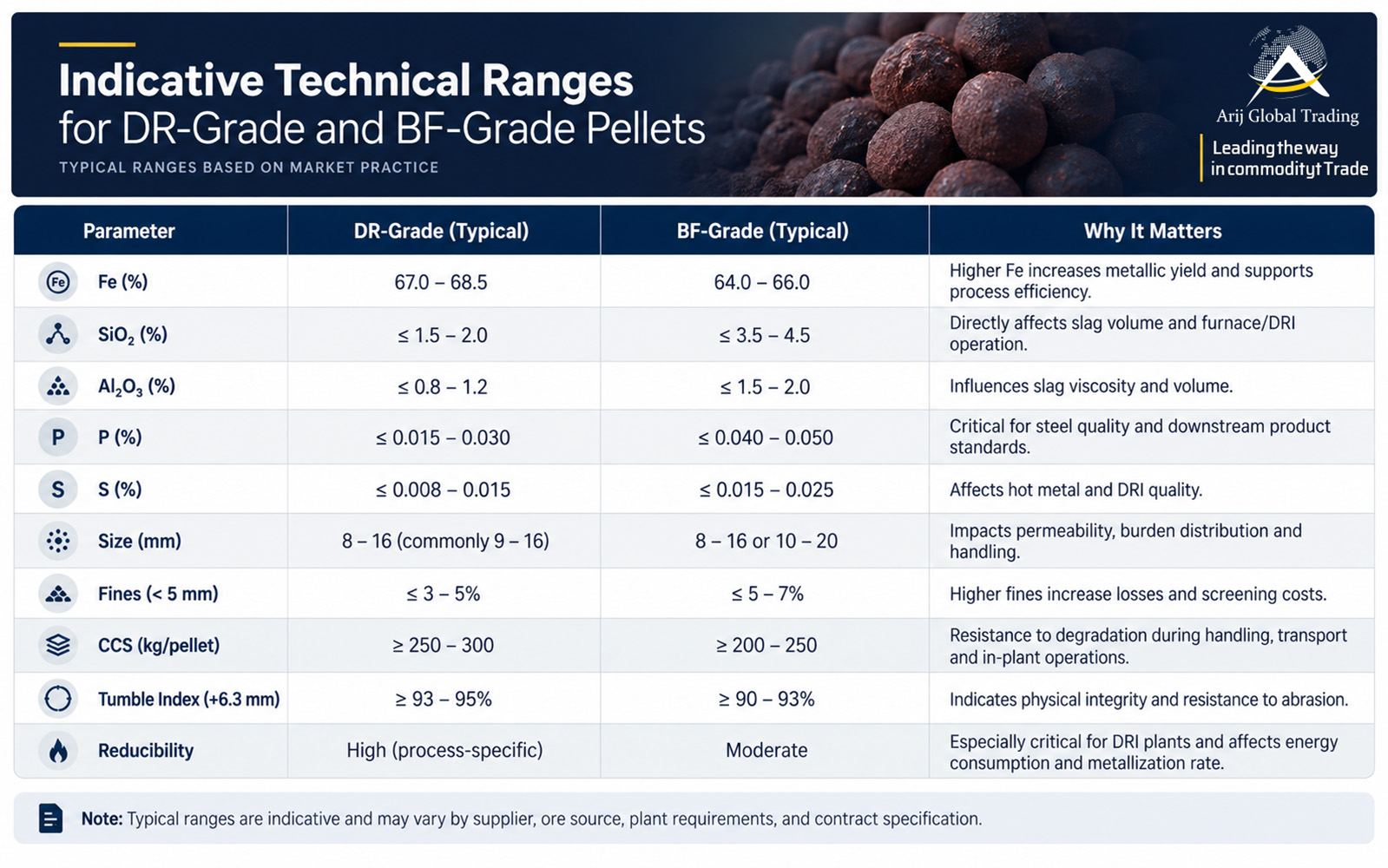
DR-Grade or BF-Grade Pellets: Which Does the Buyer Need?
Fe Grade Is Important, but Not Enough
For buyers, Fe content is one of the first specifications reviewed, but it should never be evaluated in isolation. Gangue chemistry, particularly silica and alumina, can significantly affect slag volume, energy requirements, iron yield, and downstream operating performance.
For example, two pellets with similar Fe content may deliver different process economics if their gangue levels are materially different. A pellet with around 67% Fe and lower SiO₂ may be more attractive for certain direct reduction applications than another pellet with a similar Fe level but significantly higher silica.
For DR-grade applications, higher acidic gangue can increase downstream steelmaking slag volume and reduce overall iron-unit efficiency.
Buyer Warning: A high Fe percentage does not automatically make a pellet the better commercial or operational choice. The complete chemical and physical specification should be reviewed before approving a cargo.
The correct pellet type depends on the ironmaking route.
DR-grade pellets are intended for direct-reduction applications, while BF-grade pellets are designed for blast-furnace use.
Their technical requirements are not identical.
Pellets for Direct Reduction
For DRI production, buyers generally focus on:
- High iron content
- Controlled gangue
- Consistent chemistry
- Reducibility
- Physical integrity
Buyers sourcing iron ore pellets for DRI should align pellet chemistry, physical integrity, and reduction performance with the requirements of Direct Reduced Iron (DRI) production.
For buyers assessing the wider metallics supply chain, Arijco’s bulk DRI procurement guide provides additional context on DRI sourcing, logistics, and commercial considerations.
A cargo can look attractive on paper and still underperform if its characteristics do not match the reduction process.
Pellets for Blast Furnace Use
Blast-furnace operators may evaluate a different balance of chemistry, sizing, strength, basicity, and furnace behavior.
This is why high-grade iron ore pellets should never be treated as a universal specification.
The correct question is:
High grade for which process?
That distinction can prevent expensive specification mismatches.
How Should Iron Ore Pellet Buyers Compare Suppliers?
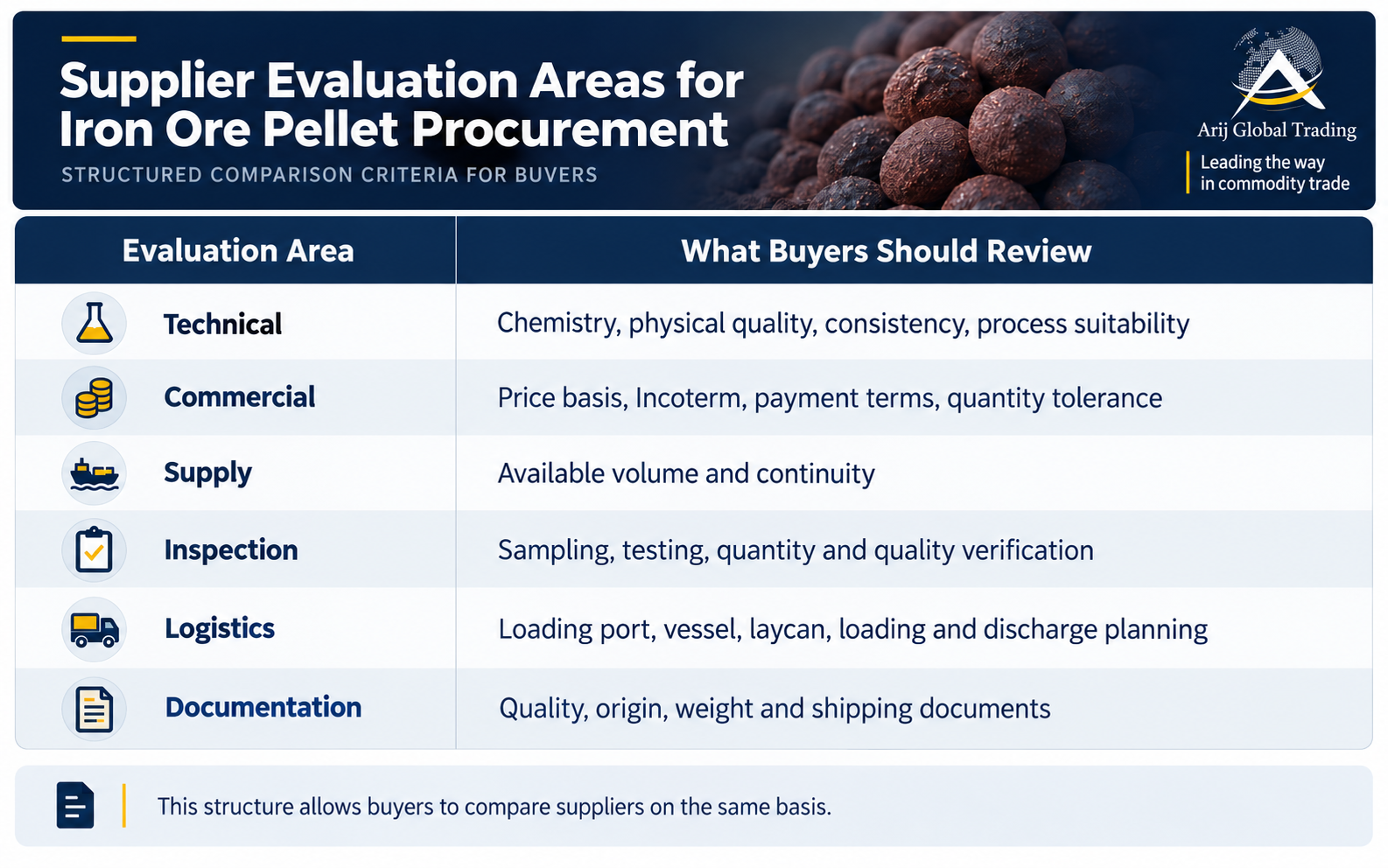
A practical supplier comparison should cover technical quality, commercial terms, supply continuity, inspection, logistics, and documentation.
Consistency Matters More Than One Strong Test Result
One attractive laboratory result does not prove long-term reliability.
For repeat procurement, buyers should ask whether the iron ore pellet supplier can maintain the agreed parameters across future shipments.
Where available, buyers should review recent quality records and request 6–12 months of historical shipment or test data to assess consistency over time. Independent verification of recent quality records remains important regardless of the supplier.
That matters because sudden changes in feed quality can affect plant performance, handling, and inventory planning.
In bulk commodity procurement, repeatability is often as important as initial compliance.
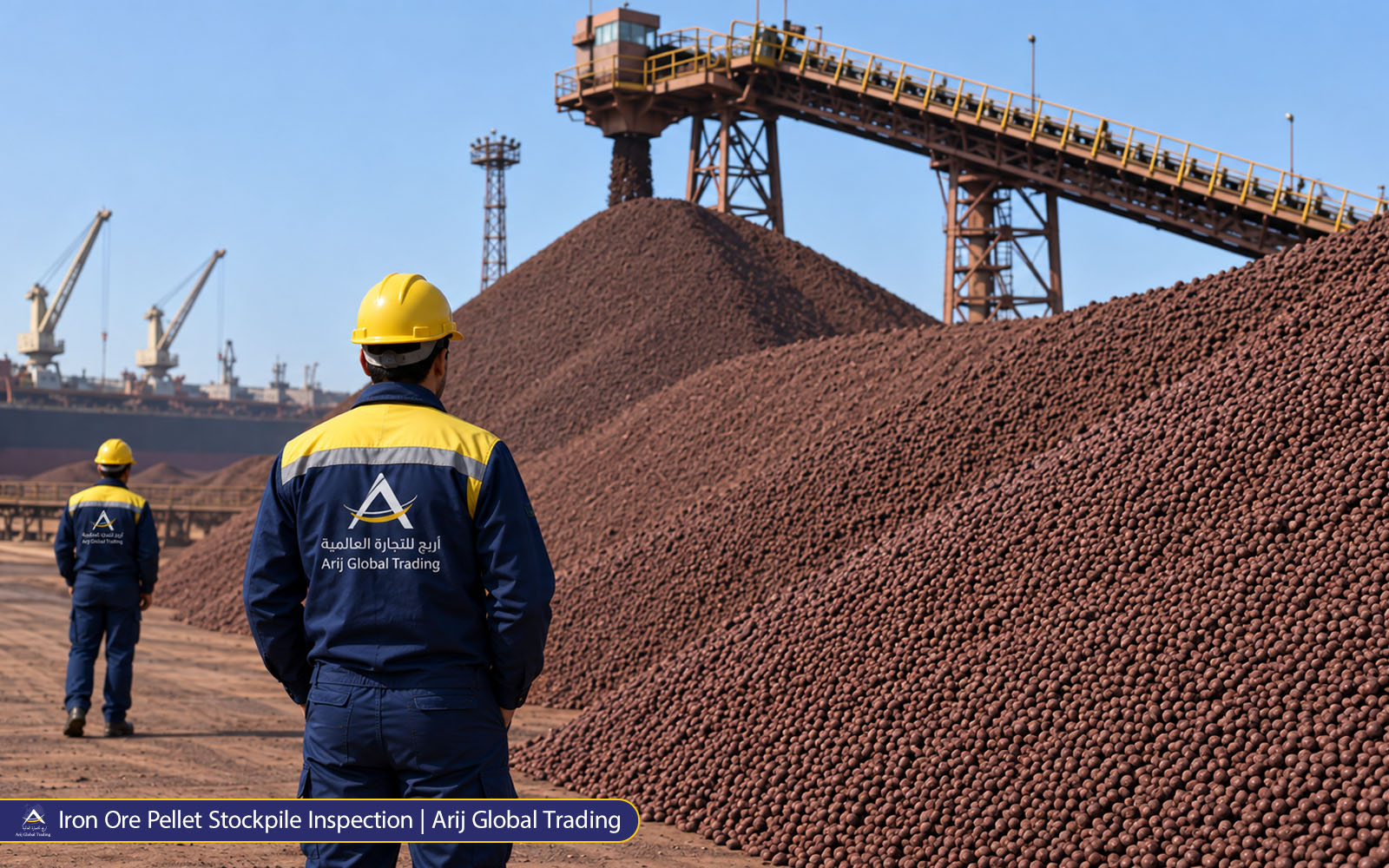
Why the Cheapest Pellet May Not Be the Lowest-Cost Pellet
A low purchase price can become expensive if the cargo creates losses elsewhere in the supply chain or plant.
Potential hidden costs include:
- Higher fines generation
- Additional screening
- Handling losses
- Lower usable yield
- Process instability
- Quality claims
- Production delays
- Additional inventory requirements
For example, a competitively priced cargo may lose part of its advantage if physical degradation increases during loading, ocean transport, or discharge.
Professional buyers therefore compare price and performance together.
Practical Procurement Example
A steel producer acting as an iron ore pellet buyer received two offers from different suppliers for DR-grade pellets with nearly identical Fe content. The lower-priced cargo appeared more attractive on an FOB basis. After shipment, however, higher fines generation and weaker physical strength led to additional screening costs, handling losses, and minor process instability at the plant.
When these costs were included in the delivered economics, the lower-priced cargo no longer provided the better overall value. In practice, selecting the right iron ore pellet supplier requires comparing consistency and usable-ton economics—not simply the lowest quoted price.
What Drives Iron Ore Pellet Prices in 2026?
Iron ore pellet prices reflect the broader iron ore market together with pellet-specific quality, production, energy, freight, and demand conditions.
Key influences can include:
- Iron ore benchmark movements
- Iron concentrate costs
- Pellet premiums
- Energy costs
- Production availability
- Regional steel demand
- DRI demand
- Blast-furnace demand
- Freight rates
- Currency movements
- Trade flows
A published iron ore pellet price therefore does not provide the complete procurement picture.
Buyers should also consider whether current raw-material costs, freight conditions, supply availability, and downstream demand support the offered price.
Compare Iron Ore Pellet Landed Cost, Not Only FOB Price
FOB prices are useful, but they do not show the full procurement cost.
An iron ore pellet landed cost calculation may include:
- Product price
- Ocean freight
- Insurance
- Inspection
- Port charges
- Discharge expenses
- Financing costs
- Inland transport
- Handling losses
As a result, two suppliers with similar FOB offers can produce very different delivered economics.
Illustrative Landed Cost Framework:
Landed Cost ≈ FOB Price + Ocean Freight + Insurance + Inspection + Port & Discharge Charges + Financing + Inland Transport + Expected Handling/Losses
FOB or CFR: Which Structure Is Better for Bulk Buyers?
Neither FOB nor CFR is automatically better.
The correct structure depends on freight expertise, market conditions, and the level of control the buyer wants.
FOB can suit buyers that:
- Have established freight relationships
- Understand the relevant freight market
- Want direct control over vessel arrangements
- Can manage shipment coordination internally
CFR may be more convenient when the seller is better positioned to arrange freight to the destination port.
However, professional importers compare the complete commercial structure.
A convenient freight arrangement is not necessarily the lowest-cost one.
Contract and Quality Adjustment Terms
For larger or repeat iron ore pellet purchases, the contract should clearly connect product specification, inspection results, pricing, and commercial responsibility.
Key provisions may include:
- Base specification and acceptable tolerance bands
- Quality-related price adjustments for agreed parameters
- Inspection method and governing test results
- Claim and dispute-resolution procedures
- Laytime, demurrage, and responsibilities for shipment delays
Some contracts may also use index-linked or formula-based pricing, particularly when buyers and suppliers want the payable price to reflect both market conditions and actual cargo quality.
The objective is not to create a more complicated contract, but to ensure that quality variation, inspection outcomes, and shipment execution have clearly defined commercial consequences before the cargo is fixed.
What Matters in an Iron Ore Pellet Bulk Shipment?
An iron ore pellet bulk shipment should protect cargo quality while matching the buyer’s port, inventory, and production schedule.
This is where practical export knowledge becomes especially important.
A cargo can meet specifications and still become commercially problematic if vessel size, loading conditions, discharge performance, or storage capacity are poorly planned.
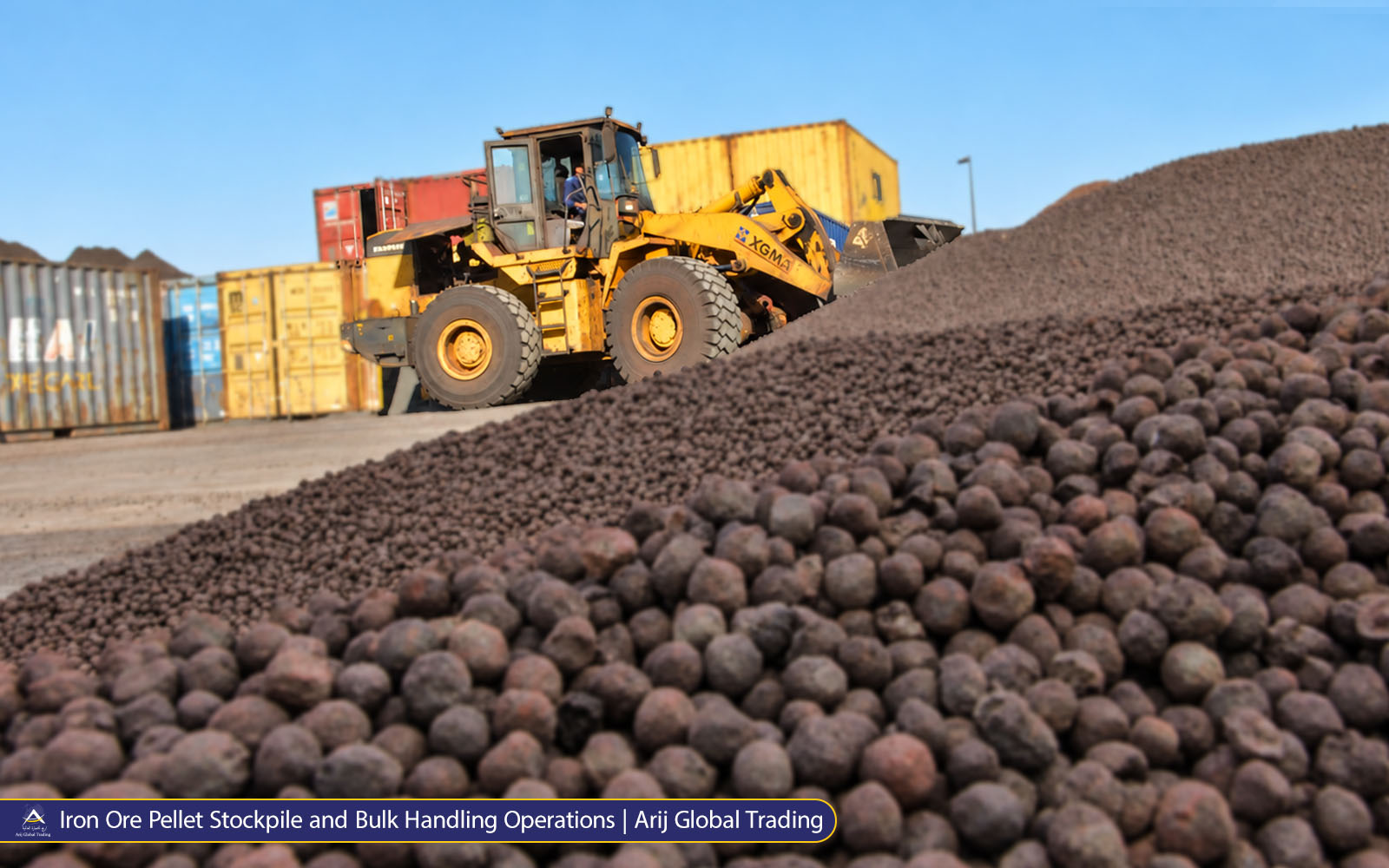
Bulk Shipment Planning Checklist
Vessel
- Vessel suitability
- Laycan
- Cargo intake capacity
- Draft compatibility
Confirm draft restrictions at both loading and discharge ports before fixing the vessel.
Port
- Loading-port capability
- Loading rate
- Destination-port restrictions
- Discharge rate
- Storage capacity
Cargo
- Cargo readiness
- Survey arrangements
- Handling conditions
- Weather exposure
When purchasing bulk iron ore pellets, buyers should confirm these points before shipment terms are finalized.
Port, Freight and Regional Logistics Considerations
Buyers should also review:
- Vessel size versus port capability
- Freight per ton
- Discharge performance
- Seasonal weather
- Local storage
- Inland transport
- Production consumption rate
A larger vessel may reduce freight per ton.
However, that advantage can disappear if draft restrictions, slow discharge, storage limits, or demurrage create additional cost.
This is why strong procurement teams look at the whole logistics chain, not only the ocean freight rate.
Procurement Considerations for Indian Ocean Steel Markets
For import-oriented steel markets, procurement efficiency depends on matching cargo economics with actual port and plant capability.
Steel producers and traders serving markets around the Indian Ocean often work with long shipping routes, carefully managed inventory, and tight working-capital requirements. Longer trade routes can increase inventory carrying costs and working-capital exposure, even when the quoted freight rate appears competitive.
Across import-oriented steel markets around the Indian Ocean, buyers may need to balance:
- Vessel size
- Freight economics
- Discharge speed
- Port restrictions
- Storage capacity
- Inland logistics
- Production consumption
- Financing requirements
The best cargo is therefore not necessarily the largest or the cheapest cargo.
It is the shipment structure that fits the buyer’s plant, port, inventory, and financing reality.
That is where regional export knowledge becomes commercially valuable.
How Can Buyers Reduce Iron Ore Pellet Procurement Risk?
Procurement risk is reduced when technical, inspection, documentation, and shipment responsibilities are agreed before the contract is signed.
Four controls are especially important.
Define the Specification Clearly
Avoid vague commercial descriptions such as “high grade” or “premium pellet” unless they are supported by clearly defined chemical and physical specifications.
Agree the Inspection Method
The contract should define:
- Who performs inspection
- Where sampling takes place
- Which laboratory or surveyor is acceptable
- How quality is determined
- How quantity is verified
Clear inspection rules reduce the risk of disputes.
Required Export and Shipping Documents
Typical documentation may include:
- Commercial invoice
- Weight documentation
- Certificate of origin
- Quality certificate
- Inspection certificate where agreed
- Bill of lading
- Destination-specific documents
Documentation requirements should be confirmed before loading.
Maintain Supply Flexibility
Depending entirely on one source creates additional exposure.
Where commercially practical, buyers should maintain alternative approved suppliers or origins.
This provides greater flexibility when production, freight, port, or market conditions change.
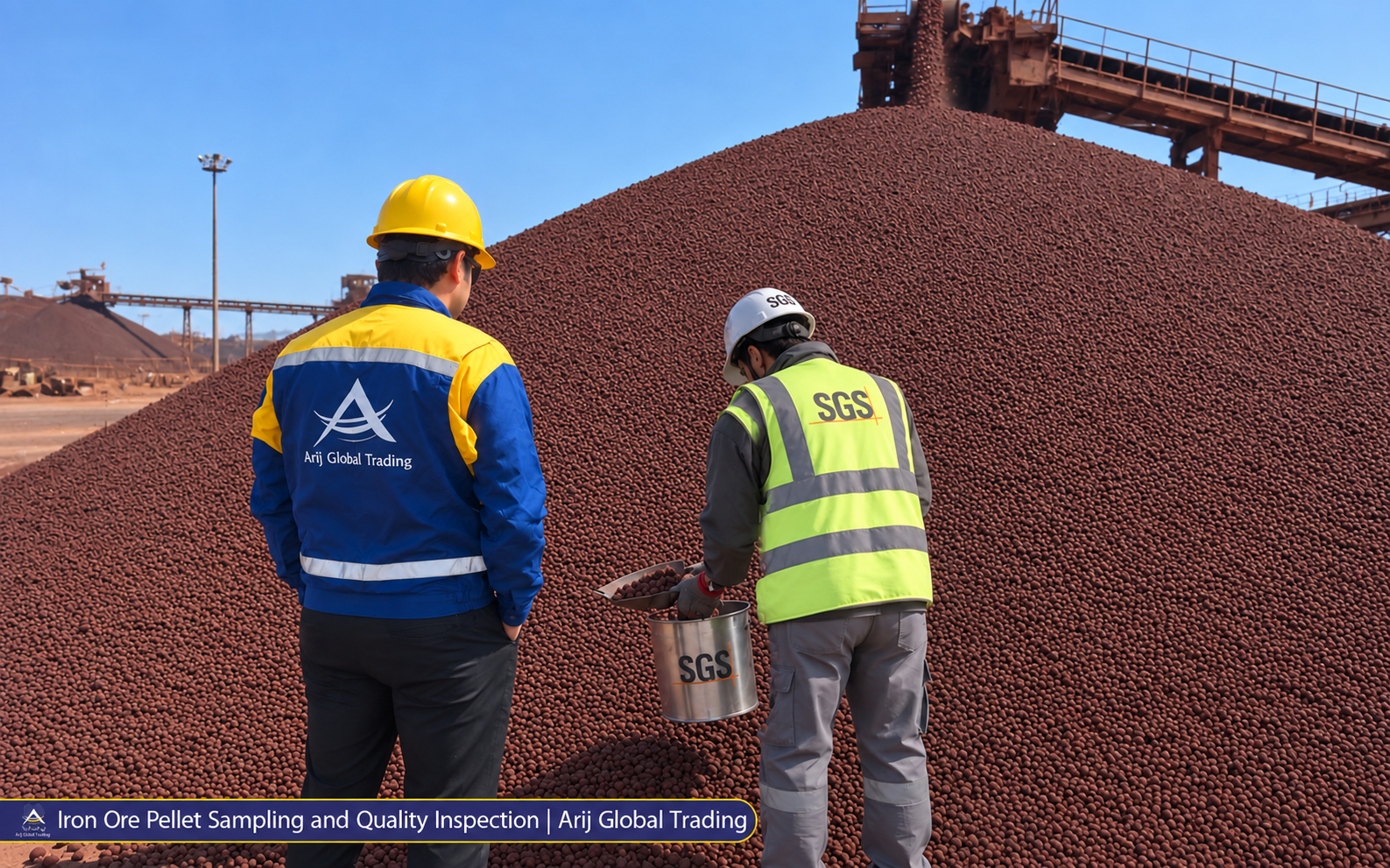
How Arij Global Trading Approaches Iron Ore Pellet Procurement
Professional iron ore pellet procurement should begin with the buyer’s actual process requirements rather than a generic product quotation.
Key parameters should be clarified early, including the intended application, chemical and physical limits, required quantity, destination port, preferred Incoterm, inspection protocol, shipment window, and commercial conditions.
That means understanding:
- Intended application
- Required specification
- Quantity
- Destination port
- Shipment period
- Preferred Incoterm
- Inspection requirements
- Commercial conditions
When these parameters are defined first, suppliers can be compared on a like-for-like basis. This reduces the risk of mismatched offers and allows buyers to evaluate technical suitability, supplier consistency, logistics capability, inspection requirements, and total landed cost together.
Independent verification of recent quality records remains important regardless of the supplier.
The principles outlined above apply equally to producers, traders, and end-users involved in bulk iron ore pellet procurement.
Information to Include in an Iron Ore Pellet RFQ
A useful RFQ should include:
- Required Fe grade
- Intended application
- Chemical limits
- Required physical properties
- Quantity in metric tons (MT)
- Destination port
- Preferred Incoterm
- Required shipment period
- Inspection requirements
- Preferred payment terms
Illustrative RFQ Example
Product: Iron Ore Pellets
Application: DRI / Blast Furnace
Fe: 66.8% min
SiO₂: 2.5% max
Size: 9–16 mm
Fines: 5% max
Quantity: 50,000 MT
Destination Port: [Port Name]
Incoterm: CFR
Shipment Period: October–November
Inspection: SGS or mutually agreed inspector at loading
Payment: LC at sight
Specifications should be adjusted to the buyer’s plant requirements, contract terms, and intended ironmaking process.
A complete RFQ enables suppliers to evaluate suitable material, commercial terms, and shipment options against the buyer’s actual requirements rather than providing a generic quotation.
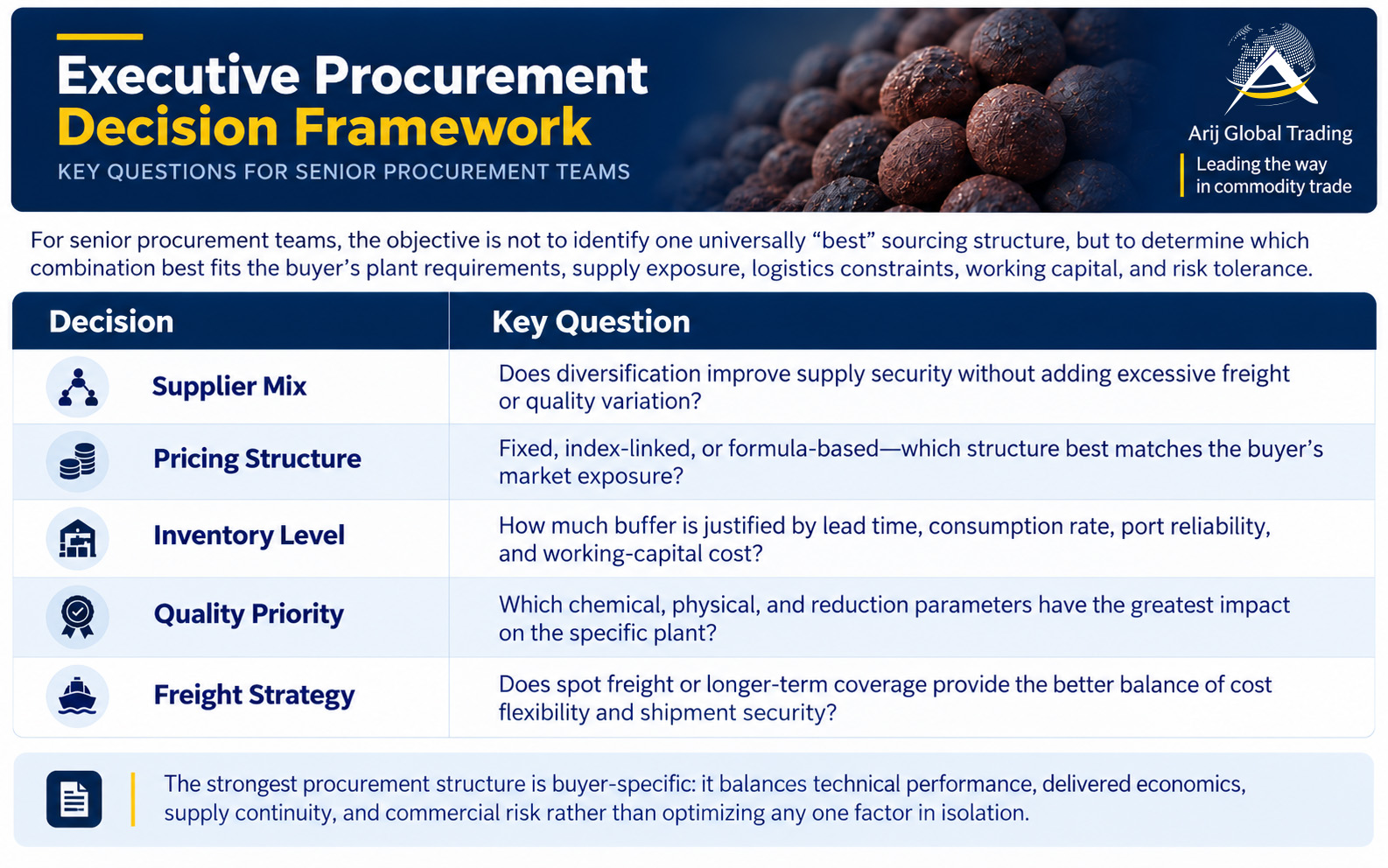
Executive Procurement Decision Framework
Frequently Asked Questions About Iron Ore Pellet Procurement
Technical and Quality Questions
What is the difference between DR-grade and BF-grade iron ore pellets?
DR-grade pellets are used in direct reduction processes and typically require higher iron content (around 67% or higher), lower gangue levels, good reducibility, and consistent physical performance.
What iron (Fe) content is recommended for DR-grade pellets?
DR-grade pellets commonly require Fe levels around 67% or higher, although the exact requirement depends on the reduction plant and agreed specification.
However, Fe content should not be evaluated alone. Buyers should also define limits for SiO₂, Al₂O₃, phosphorus, sulfur, fines, physical strength, reducibility, and other process-specific parameters.
What physical properties should be checked for iron ore pellets?
Key physical properties include pellet size distribution (commonly 9–16 mm), percentage of fines below 5 mm, cold compression strength (CCS), and tumble or abrasion index. For DR applications, reducibility and swelling behavior are also important. Weak pellets can generate excessive fines during handling and transport, causing yield loss and operational problems.
Commercial, Logistics and Procurement Questions
What is included in the landed cost of iron ore pellets?
Landed cost includes the FOB price plus ocean freight, insurance, inspection fees, port charges at destination, discharge costs, financing charges, inland transportation, and an allowance for handling losses. Comparing only FOB prices can be misleading because logistics and quality losses can significantly change the final cost per usable ton.
Is FOB or CFR better for buying iron ore pellets?
Neither is universally better. FOB gives the buyer more control over freight and vessel selection, which can be advantageous if the buyer has strong shipping expertise. CFR is more convenient when the seller can arrange reliable and cost-effective freight. The best choice depends on the buyer’s logistics capability, market conditions, and risk tolerance. Always compare the total delivered cost.
What documents are required when importing iron ore pellets?
Typical shipping and quality documents include commercial invoice, bill of lading, certificate of origin, weight certificate, quality certificate (chemical and physical analysis), and inspection certificate if third-party survey is used. Destination-specific documents such as import licenses or customs declarations may also be needed. All documentation requirements should be agreed before loading.
How can buyers reduce risk when purchasing iron ore pellets?
Define a clear specification with chemical and physical limits, agree on the inspection method and sampling point, confirm vessel and port logistics before shipment, and maintain flexibility by qualifying more than one supplier or origin. Avoid relying solely on one laboratory result; instead, request historical performance data to assess consistency.