
Two quotations may list the same grade and diameter but provide different levels of quality evidence. For a rebar buyer, the decisive question is whether the actual reinforcement can be identified, tested and accepted under the contract, not which invoice appears cheapest.
For mixed orders, verify more than material test results: an unavailable diameter, unapproved mill or uncertain dispatch date can disrupt the entire basket. Set the acceptance criteria and item-by-item sourcing requirements before comparing quotations.
Quick answer: Check the standard and grade; mechanical results; chemistry and weldability; nominal mass, dimensions and identification; mill test certificates (MTCs) and heat traceability; inspection and release rules; and cargo condition. Then confirm that the complete product mix is available on an agreed schedule.

1. Confirm the Standard, Edition and Grade
Specify the governing standard, edition, grade, bar designation, lengths, quantity and project-specific requirements. Similar yield-strength labels do not establish equivalence between different standards.
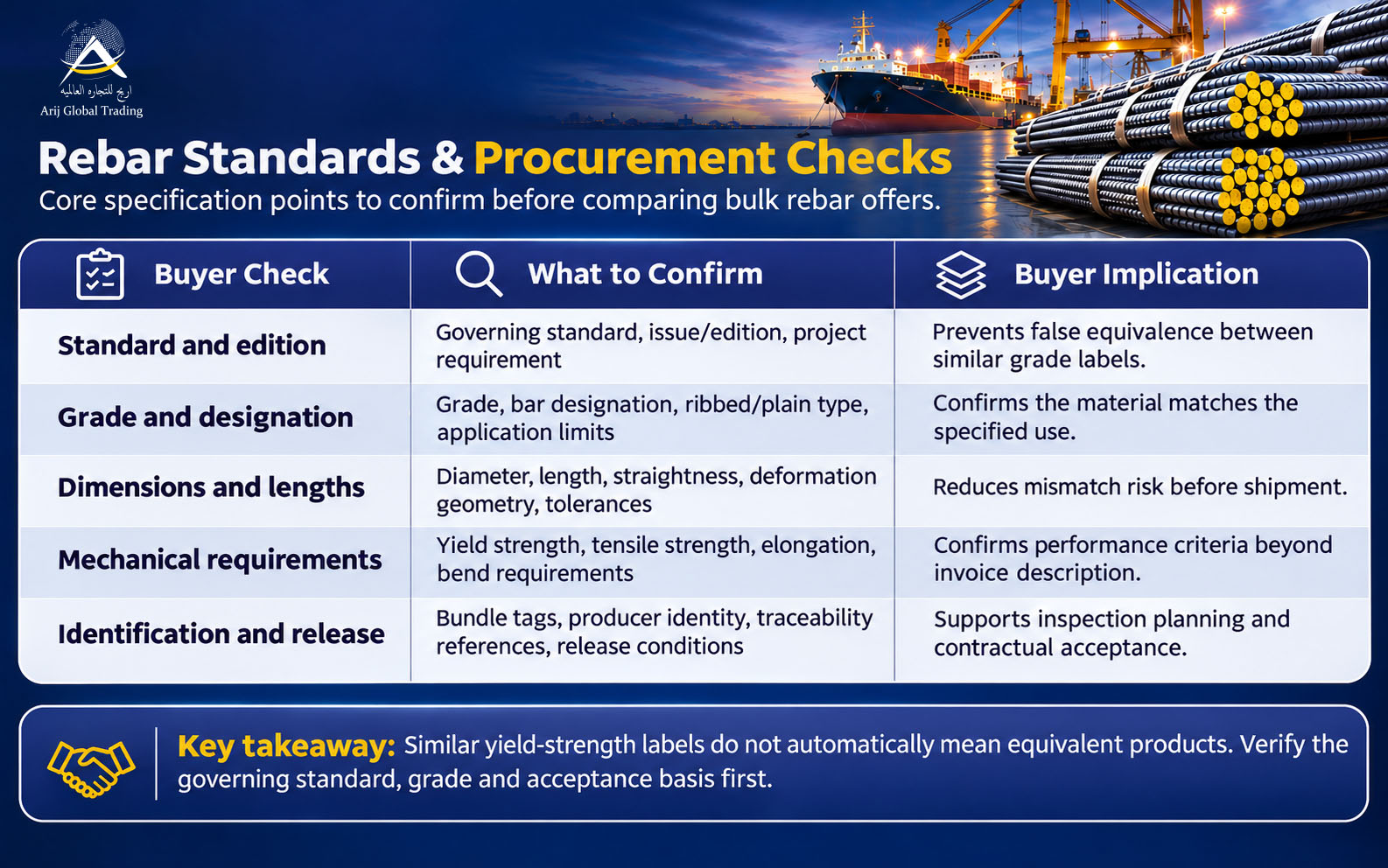
Action: Ask the rebar supplier for the contracted specification and written approval of any substitution.
2. Verify Mechanical Test Results
Request identifiable results for yield strength, tensile strength, elongation, tensile-to-yield relationship and bend tests when required. A passing strength result does not override a failed ductility requirement. Match each report to the relevant heat or test unit, using the specified sampling rules.
Action: Hold material with incomplete or nonconforming results until the authorized technical party resolves the discrepancy.
3. Check Chemistry and Weldability
Chemical analysis and carbon-equivalent limits matter when welding is planned. ASTM A706 includes weldability-related controls, but a suitable welding procedure is still required. ASTM A615 bars should not automatically be called unweldable: suitability depends on the chemistry, code and application. Specify any applicable welding requirements, including AWS D1.4/D1.4M where required by the project.
4. Check Nominal Mass, Dimensions and Identification
Check bar designation, length, unit mass, deformation geometry, straightness and permitted deviations under the contracted standard. Rolled markings and bundle tags support identity but do not prove chemical or mechanical compliance.
Illustrative mass screening: approximately 0.00617 × d² kg/m for nominal diameter d in millimetres. A 16 mm bar has an estimated nominal mass of 1.58 kg/m, equivalent to approximately 19.0 kg for a 12 m length. This calculation is for preliminary estimation only, not a universal tolerance or acceptance test for deformed bars. Use the applicable standard’s nominal mass tables, tolerances and sampling requirements.
5. Verify the MTC and Heat-to-Bundle Traceability
The MTC should identify the producer, specification, grade, relevant test values and traceability references. Reconcile the chain MTC → heat/test unit → bundle tag → packing list → loaded cargo. For mixed heats or mills, preserve a separate traceability record for every relevant lot.
Example: If a certificate identifies heat H-1024 and a bundle tag reads H-1027, investigate before release; do not assume either record is correct.
If EN 10204 documents are contractually required, Type 3.1 entails manufacturer inspection validation independent of manufacturing operations; Type 3.2 adds the prescribed purchaser or officially designated inspection validation. Neither is automatically mandatory for every shipment.

6. Set Inspection Hold Points and Nonconformity Rules
Agree who samples and tests material, when checks happen, what acceptance criteria apply and who authorizes release. For independent laboratory testing, confirm that the ISO/IEC 17025 accreditation scope covers the relevant methods.
On a failure: hold → identify → record → investigate → retest only if permitted → obtain the authorized disposition.
A discount cannot make unsuitable material technically acceptable.
7. Check Cargo Condition and Accepted-Tonne Cost
A rebar exporter should be able to explain how bundle tags, packing records and cargo identity are preserved through storage, loading and shipment. Check damage, distortion, contamination and significant corrosion; surface rust alone is not necessarily grounds for rejection.
A delivered quotation does not necessarily reflect the effective cost of contractually accepted rebar. Before comparing offers, buyers should align the product specification, Incoterm, delivery scope, inspection evidence and contractual remedies. These factors help determine whether two quotations are commercially comparable.
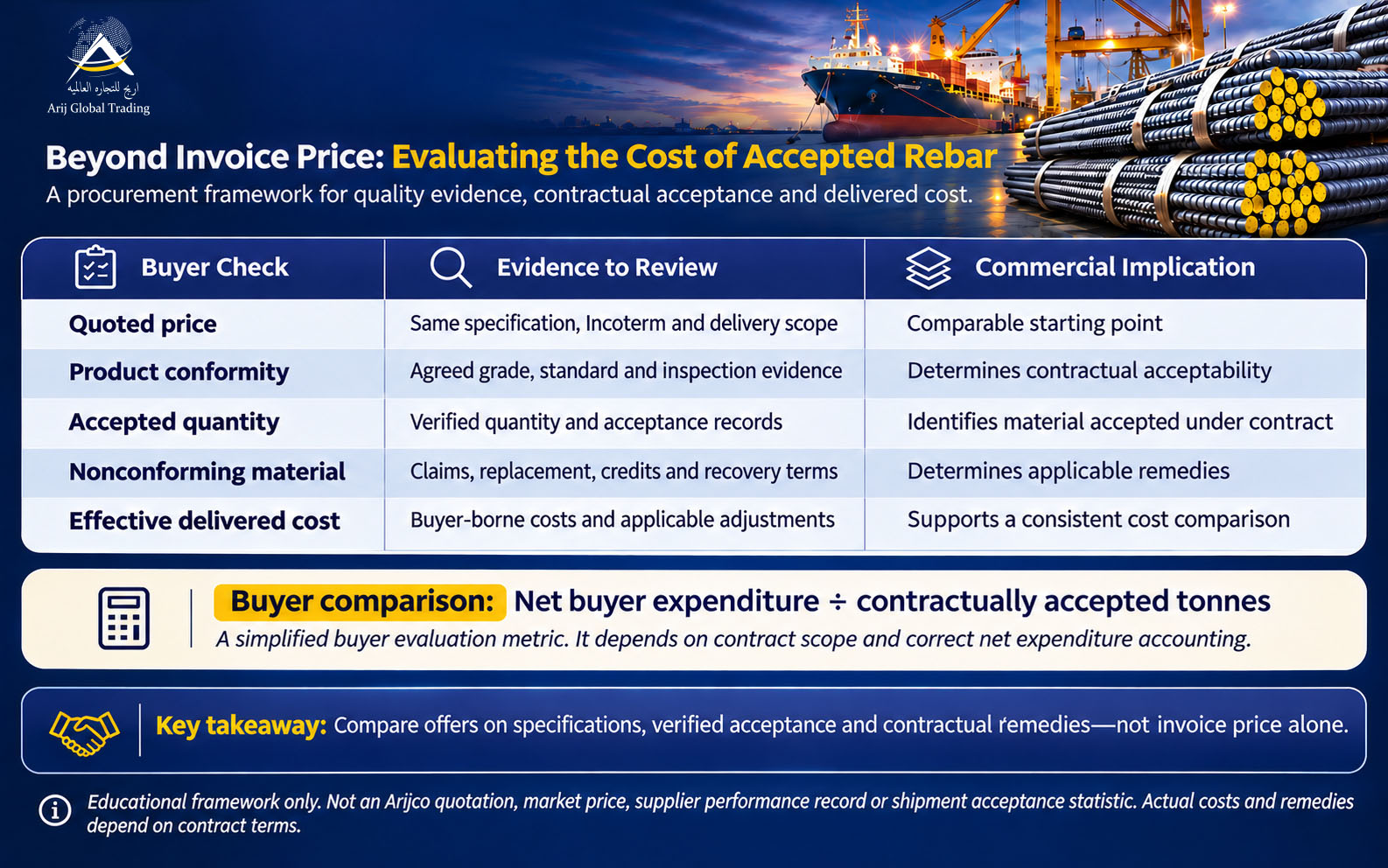
Procurement decision rule: When a cost-per-accepted-tonne comparison is appropriate, divide net buyer expenditure by the quantity contractually accepted. Include applicable buyer-borne costs and account for credits, recoveries and agreed remedies without double counting. Compare offers on a consistent specification and contractual basis.
This framework is educational and does not represent an Arijco quotation, current market prices or actual supplier acceptance statistics.
Mixed-Size Rebar Orders: Three Procurement Problems to Solve
1. The complete size-and-grade basket. Mixed-size rebar orders may combine different diameters, grades and quantities. List each item separately, specifying the applicable standard and edition, grade, diameter, length, required tonnage and approved producers. Maintain traceability for each heat or test unit, even when several lots are consolidated into one shipment.
2. Product range and multiple sources. A broad product range is valuable only when every item meets the buyer’s approved specification. If an order involves multiple mills, confirm producer eligibility, grade-specific documentation and certificate requirements for each line. Do not treat materials from different heats or mills as a single undifferentiated lot.
3. Diameter coverage and delivery readiness. A mixed-size order may include 8, 10, 12, 14, 16, 18, 20, 22, 25 or 32 mm rebar, subject to mill capability and confirmed availability. Request item-specific confirmation of minimum order quantities, production readiness, lead times and dispatch schedules. Compare consolidated shipments with phased deliveries where commercially appropriate.
Grade terminology: In Iranian market terminology, A1 generally refers to plain reinforcing bars, while A2, A3 and A4 identify different ribbed rebar categories. These designations must not be treated as automatic equivalents of ASTM, BS or ISO grades. Confirm the applicable standard, grade, mechanical requirements and permitted substitutions against the project specification. Availability of A4 grades, producer brands and individual diameters must be verified for each quotation.
Seven Verification Gates: Evidence and Decision
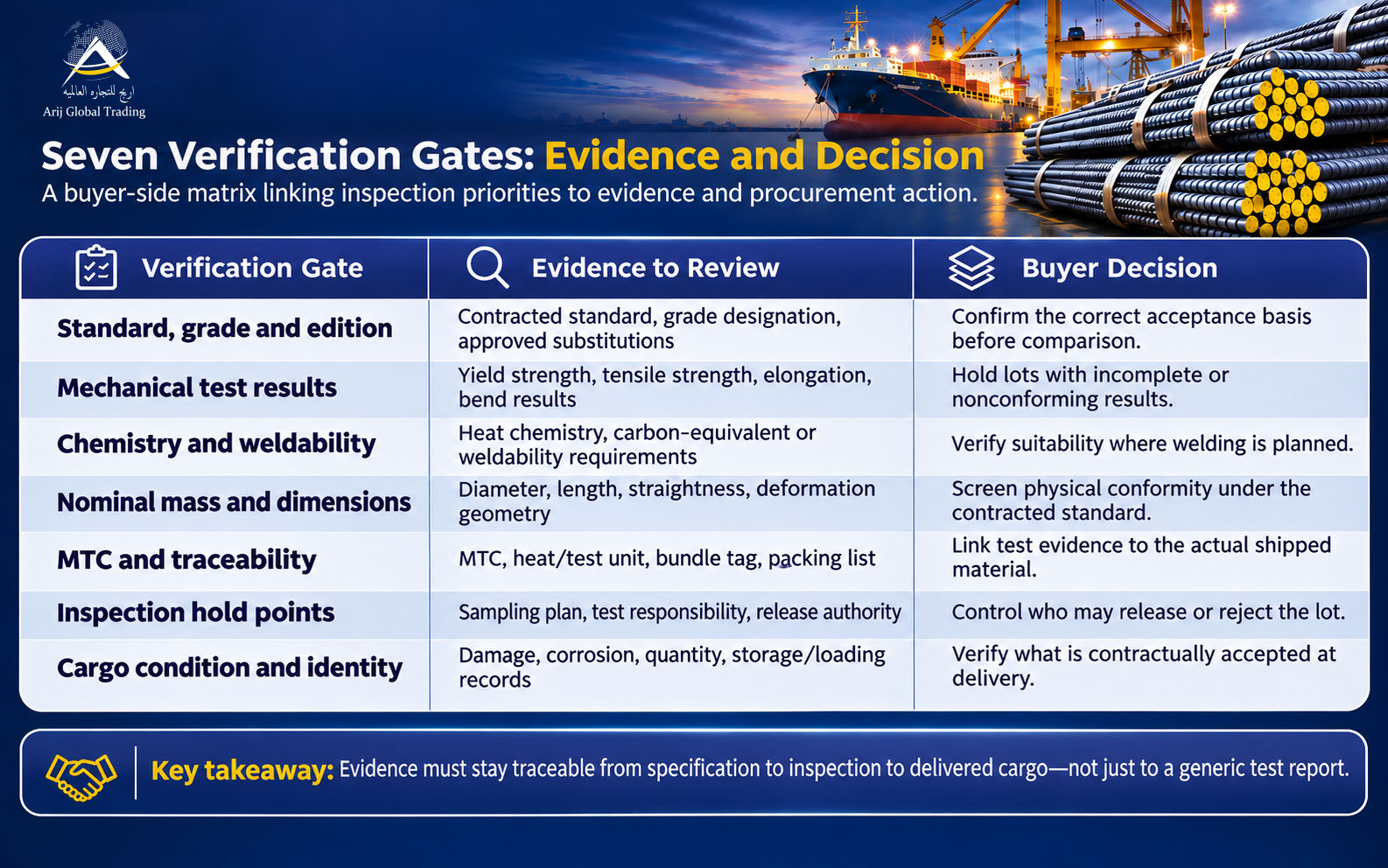
The matrix supports planning only; acceptance limits and sampling frequencies come from the applicable contract and product standard.
Send a Line-by-Line Mixed Rebar RFQ
For each line, specify the applicable standard and edition, grade, diameter, length, required tonnage, permitted mill or brand and certificate type. For the complete basket, state destination, Incoterm, packing, delivery deadline and whether staggered delivery is acceptable. Request a supplier response against every line: offered quantity, originating mill, confirmed or conditional availability, earliest realistic dispatch, exceptions and traceable inspection documents.
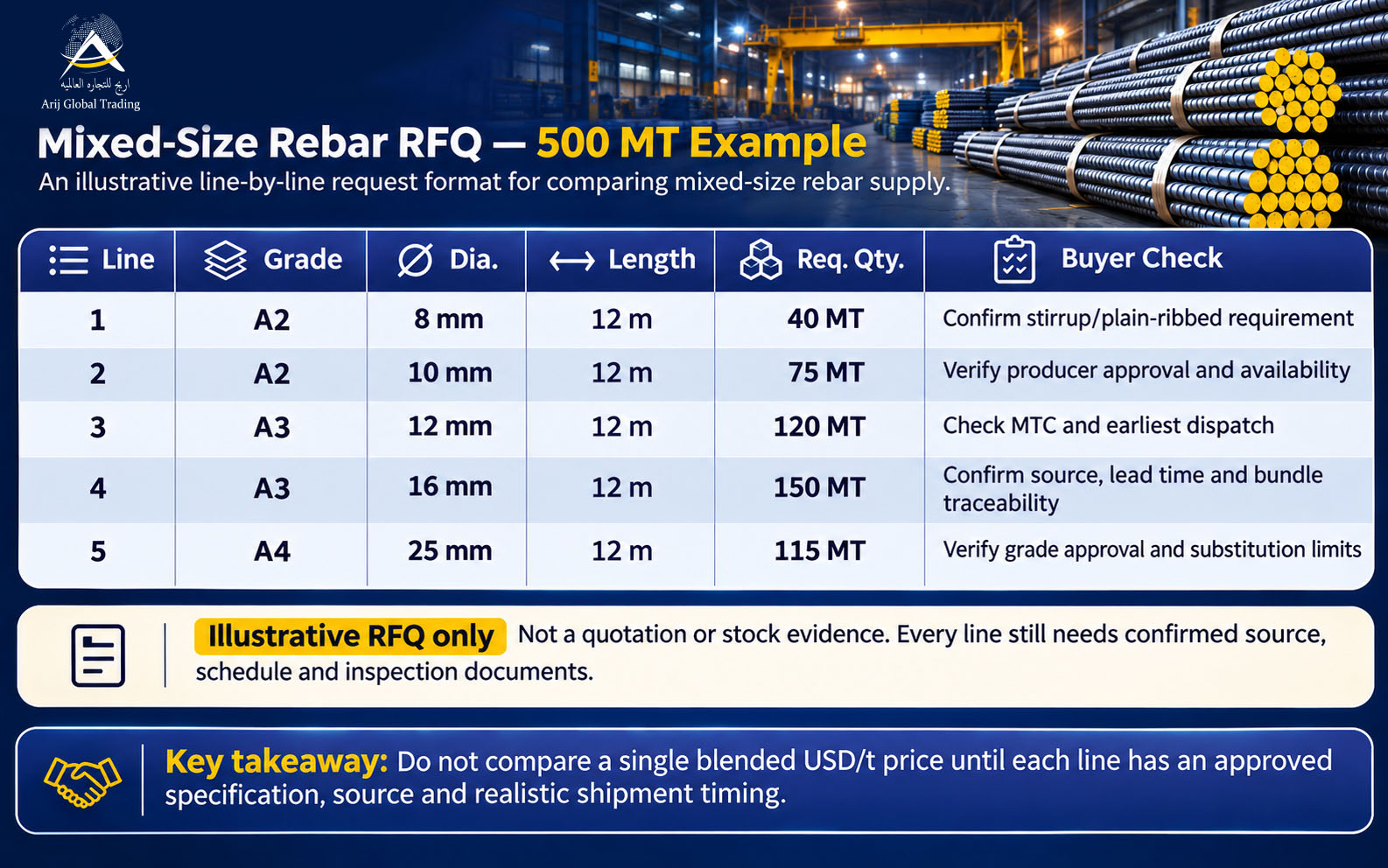
The 500 MT schedule is an illustrative RFQ, not stock evidence or a quotation. Arijco’s product page states a 500 MT MOQ, but that does not prove the feasibility of this precise mix or establish individual-size minimums. Obtain written confirmation for each grade, diameter, source, lead time and consolidation plan. Where one item is unavailable, compare an approved substitute or staged delivery rather than silently changing the specification.
Procurement decision rule: Do not compare a single blended USD/t price until each line has an approved specification, source and realistic shipment timing. A consolidated quotation is useful only when the technical evidence remains traceable by mill, heat and bundle.
Frequently Asked Questions About Rebar Quality Inspection
Is an MTC enough to accept a shipment?
No. Its results must match identifiable material and all contractually required checks.
Can ASTM A615 and A706 be substituted?
Not automatically. The responsible engineer must approve differences against the project requirements.
Is EN 10204 Type 3.2 always necessary?
No. The contract and applicable requirements determine the inspection-document type.
Does a theoretical 16 mm mass prove compliance?
No. Use the governing standard’s mass tables, tolerances and sampling requirements.
Is surface rust always a rejection reason?
No. Evaluate its extent and consequences against specified acceptance criteria.
How should buyers evaluate a bulk rebar supplier?
Buyers should confirm the supplier’s ability to meet the agreed rebar grades, diameter range, quantities and delivery schedule. Request applicable mill test certificates, heat or batch traceability, inspection arrangements and written confirmation of any mixed-size order requirements. Commercial offers should also specify the Incoterm, shipment terms and how substitutions or deviations will be handled.
What should buyers verify before accepting a rebar shipment
Before acceptance, buyers should verify the agreed standard and grade, dimensions, quantity, bundle identification and traceability to supporting documents. Review the mill test certificates and agreed inspection results, check for visible damage or significant corrosion, and record any discrepancies. Final acceptance should follow the contractual requirements and applicable inspection criteria.
Technical References and Limits
Technical basis: product standards and inspection-document specifications listed below. These references explain the applicable framework, but publicly available publisher summaries do not establish every licensed acceptance limit. The purchase contract, project design, official standard editions and authorized inspection plan control final decisions.
BS 4449:2005+A3:2016 and BS EN 10204:2004: confirm the applicable licensed versions and clauses before lot-specific decisions.