
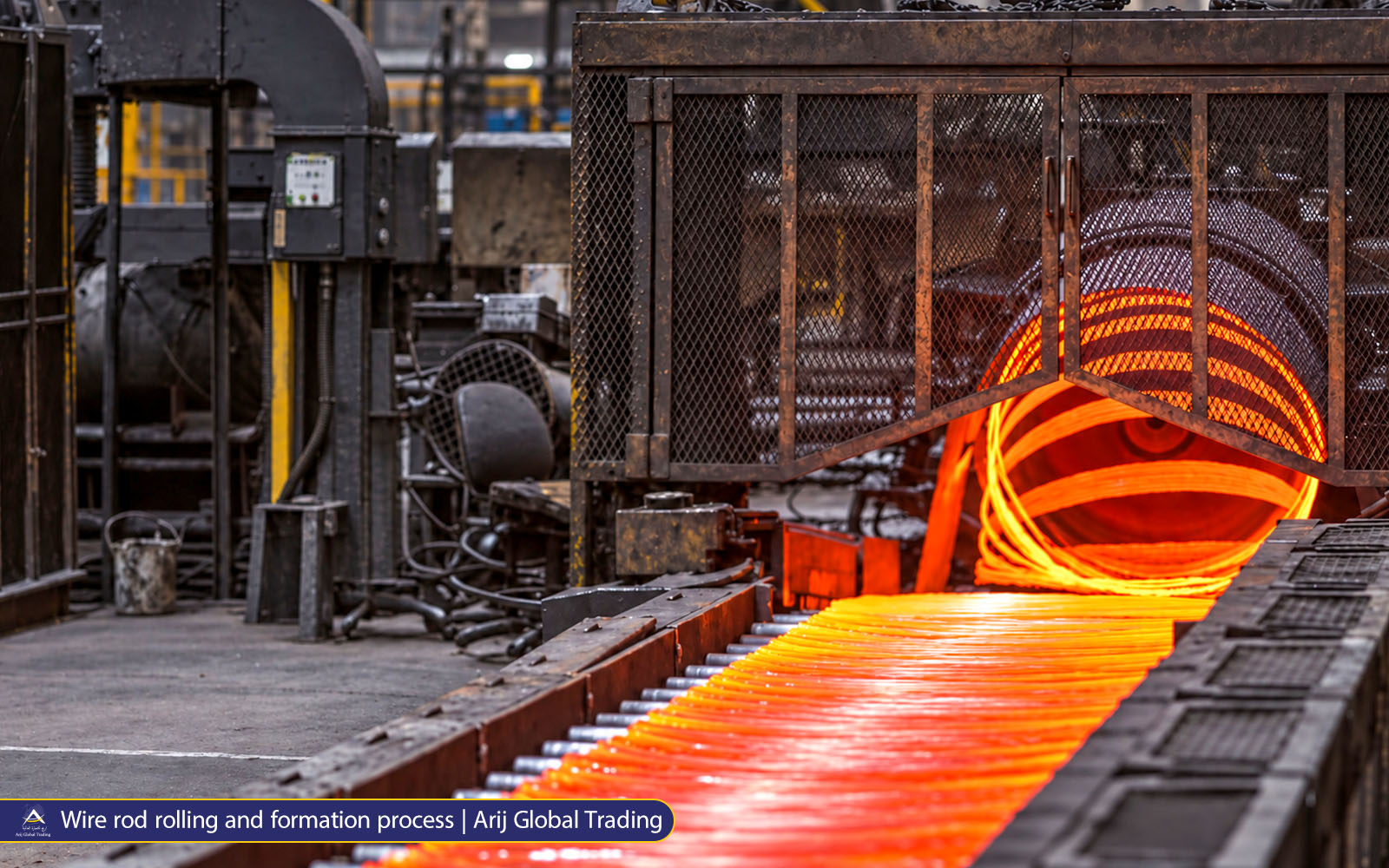
Introduction: Why Wire Rod Procurement Requires More Than Price Comparison
Introduction: Why Wire Rod Procurement Requires More Than Price Comparison
In international steel procurement, selecting the right wire rod is not only a matter of comparing prices. For industrial buyers, importers, and traders, a successful purchase decision depends on several interconnected factors: wire rod specifications, application requirements, supplier reliability, documentation accuracy, shipment planning, and total delivered cost.
A procurement decision that focuses only on price can create challenges later in the supply chain. Specification mismatches, inconsistent quality, delayed shipments, or incomplete documentation can affect production schedules, increase operational costs, and create uncertainty for manufacturers relying on stable material supply.
This guide covers the complete purchasing process, from understanding technical requirements and evaluating suppliers to selecting the right shipment method and managing logistics risk.
For international buyers, working with an experienced wire rod supplier provides access to coordinated sourcing, technical evaluation, and export support, connecting product requirements with commercial realities such as availability, shipment timing, and destination-specific requirements.
What Buyers Should Confirm Before Purchasing Wire Rod
Wire Rod Specifications That Affect Downstream Performance
Understanding the Importance of Wire Rod Specifications
Wire rod performance is determined by more than price and availability. The relationship between steel characteristics and the final application directly shapes production efficiency, product quality, and overall procurement value.
A wire rod product that meets nominal specifications on paper can still underperform on a buyer’s production line if the underlying properties are not matched to the intended process.
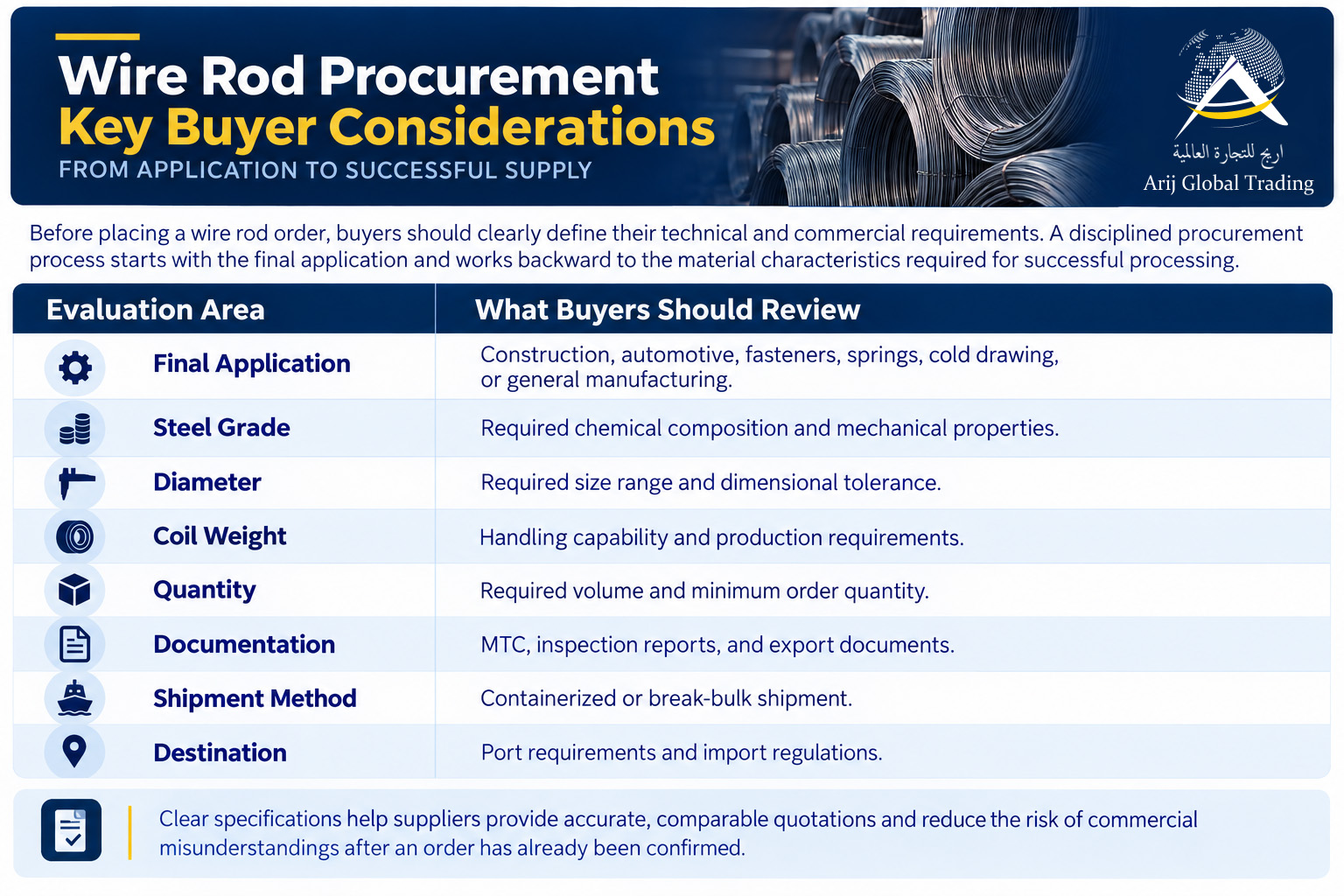
Before confirming an order, buyers should evaluate:
- Steel grade
- Chemical composition
- Diameter range
- Dimensional tolerance
- Coil weight
- Surface condition
- Mechanical properties
Grade and Chemical Composition
Grade selection starts with carbon content, since it directly influences strength, hardness, and how the material responds to further processing.
Low-carbon wire rod is generally easier to draw and form, which is why it is commonly selected for applications such as nails, mesh, and general fabrication. Higher-carbon and alloyed grades are selected where strength, fatigue resistance, or wear performance are more important, including fasteners and spring applications.
Composition affects industries differently:
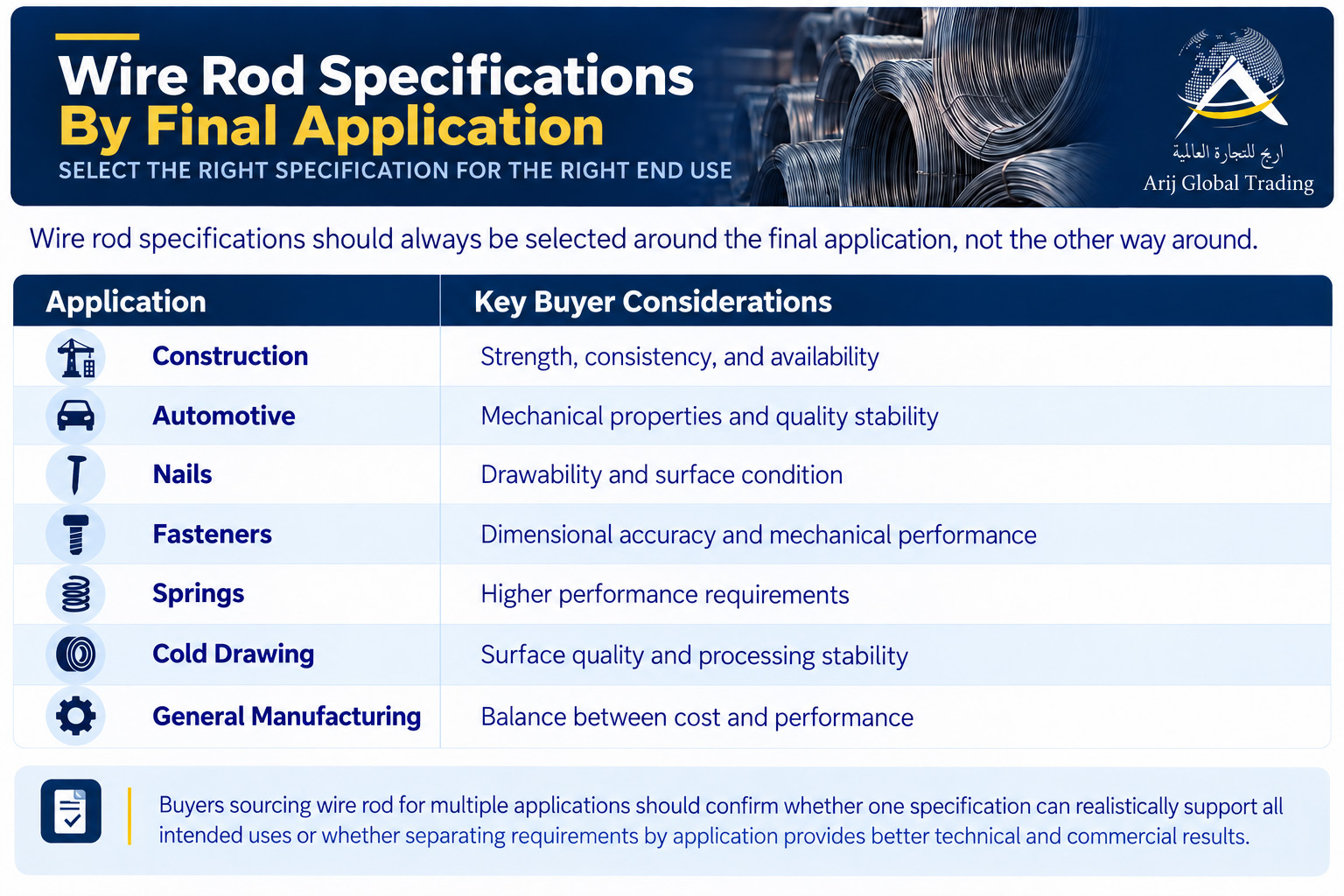
- Construction applications prioritize consistent mechanical performance and reliable availability.
- Automotive applications typically require tighter and more stable chemical control because components must meet stricter performance and safety requirements.
- Cold drawing operations depend on both surface condition and composition consistency; variation between coils can create unpredictable drawing behavior even when individual coils meet specification.
- Fastener and spring manufacturing prioritize mechanical performance, including tensile strength and fatigue resistance.
Because of this, buyers should confirm that the agreed grade and chemical requirements are clearly stated in the purchase contract, and verifiable against the Mill Test Certificate, rather than referenced only as a generic “standard grade.”
Diameter, Tolerance and Wire Rod Coil Weight
Diameter consistency plays a direct role in downstream processing. Even small dimensional variations along a coil can affect drawing operations, forming processes, and final product performance particularly for buyers operating continuous, high-speed production lines where tooling depends on narrow tolerance windows.
Parameter Specification
Diameter 5.5 – 16 mm
Coil Weight 200 kg – 3 MT
MOQ 500 MT
Smaller diameters (5.5–8 mm) are typically further processed for fine wire, nails, and mesh applications, while larger diameters (10–16 mm) are commonly used in construction and general fabrication where less downstream reduction is required.
Wire rod coil weight should be evaluated against three factors: production requirements, warehouse handling capability, and transportation conditions.
Heavier coils can reduce coil-change frequency and improve line efficiency for continuous operations. However, they also require compatible lifting equipment at both origin and destination. A coil size suitable for supplier loading operations is not automatically suitable for the buyer’s receiving facility.
Surface Condition and Dimensional Consistency
Surface condition and dimensional accuracy are critical for buyers who process wire rod further rather than using it directly.
Surface defects such as scale, pitting, seams, or surface decarburization can increase the risk of die damage, drawing breakage, inconsistent finished dimensions, and higher scrap rates.
Buyers should evaluate:
- Surface quality
- Dimensional consistency along the coil
- Processing suitability for the intended method
- Quality stability between coils
For cold drawing, fasteners, and automotive components, consistent material performance reduces production interruptions and protects manufacturing efficiency.
A qualified supplier should be able to discuss process controls and typical tolerance performance, not only quote nominal specifications, because two suppliers offering the same nominal diameter may perform differently on a buyer’s production line.
Matching Wire Rod to the Final Application
Define the Specification Before Comparing Prices
- A clear specification should be established before suppliers compete on price. Broad requests such as “high-grade pellets” can lead to mismatched offers, inconsistent comparisons, and avoidable procurement risk.
How Can Steel Buyers Identify a Reliable Wire Rod Supplier for Bulk Orders?
How Can Steel Buyers Identify a Reliable Wire Rod Supplier for Bulk Orders?
Bulk wire rod orders carry more risk than smaller purchases, since the impact of a mistake increases with volume. For example, a specification mismatch, documentation issue, or missed delivery window on a 500 MT order can disrupt production schedules,
tie up working capital, and create additional costs throughout the supply chain.
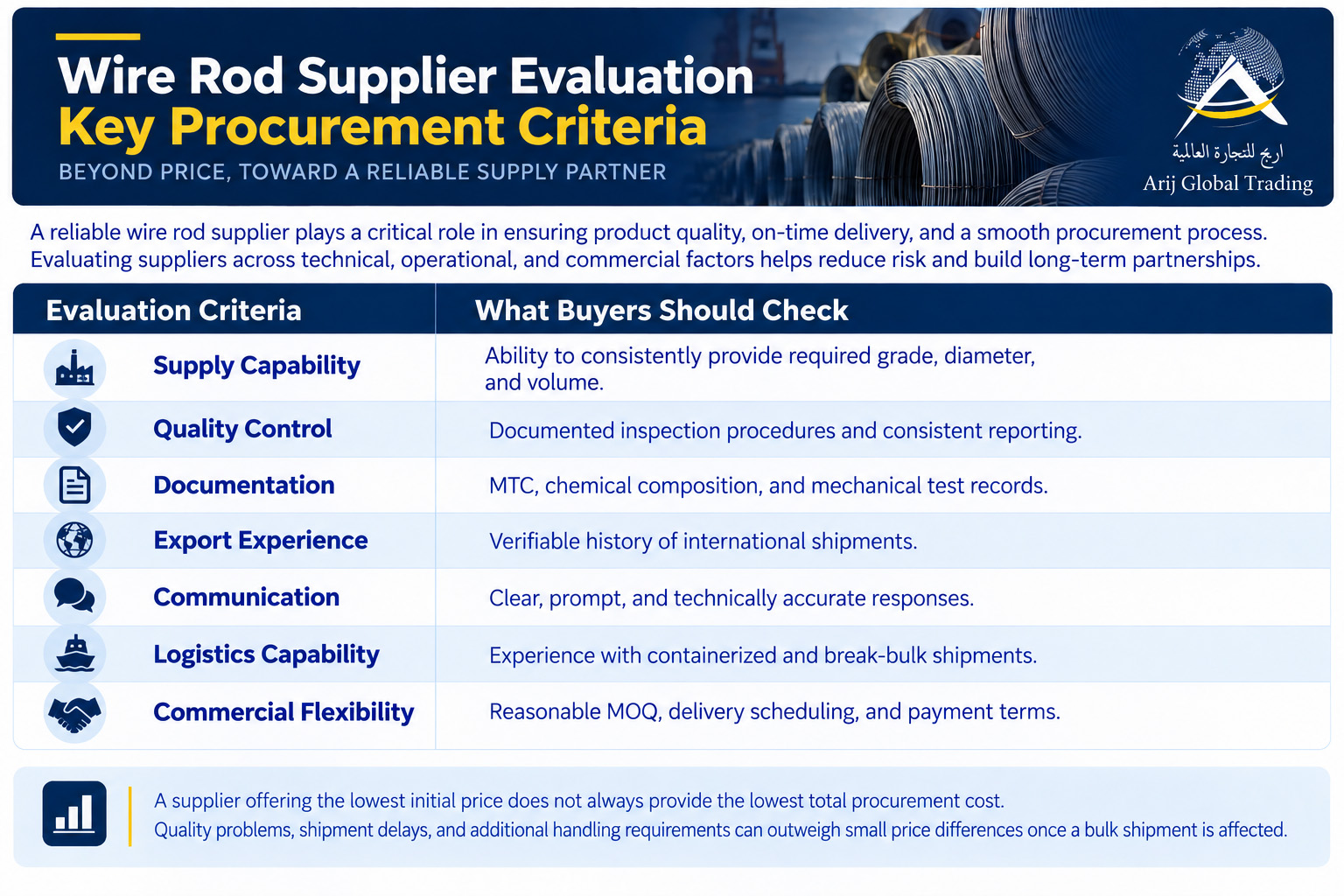
For this reason, selecting a supplier should involve more than comparing quotations. Ultimately, a dependable supplier should demonstrate the ability to maintain specification consistency, provide accurate documentation, and support the complete shipment process from order confirmation through delivery.
Core Criteria for Evaluating a Wire Rod Supplier
Red Flags That Signal Supplier Risk
Certain warning signs often appear before a bulk order problem occurs. Identifying these risks early helps buyers avoid costly disruptions after shipment confirmation.
- Reluctance to provide documentation. Hesitation to provide an MTC, chemical composition report, or quality records before shipment should be treated as a warning sign rather than a minor administrative issue.
- Specification differences between quotation and shipment. Changes in agreed properties without clear explanation may indicate inconsistent sourcing practices.
- No defined inspection process. A supplier should be able to explain how quality is verified before loading and how conformity with specifications is maintained.
- Pricing significantly below market levels without a clear reason. A large price difference may reflect differences in grade, availability, quality, or commercial conditions.
- Slow or unclear technical communication. Weak communication during quotation and specification review can create larger issues during execution.
- No verifiable export history. Buyers should understand whether a supplier has experience handling comparable international shipments.
- Pressure for full upfront payment without verification. Commercial terms should be supported by proper documentation, transparency, and buyer confidence.
Taken together, multiple warning signs appearing at once should encourage buyers to conduct additional verification before committing to a large-volume order.
Documents and Inspection Requirements
Professional buyers evaluate documentation before shipment, not after arrival. Proper documentation provides evidence that the supplied material matches the agreed specification and commercial terms.
Key documents commonly reviewed include:
Mill Test Certificate (MTC) — verifies chemical composition and mechanical properties against the ordered grade
Chemical composition report — confirms actual composition matches the contractual specification
Mechanical test results — tensile strength, elongation and other properties relevant to the application
Inspection certificate — third-party or mutually agreed verification, where required
Packing list — confirms coil count, weights and total shipment quantity
Certificate of Origin — required for customs clearance and, in some markets, preferential tariff treatment
The value of documentation is not only the existence of records but the consistency between quotation, purchase agreement, inspection results, and delivered cargo.
Reviewing documents before shipment allows buyers and suppliers to resolve potential discrepancies while corrective action is still possible.
Third-party inspection from organizations such as SGS, Bureau Veritas, or equivalent inspection providers can add an additional level of verification for larger orders or first-time supplier relationships.
Packaging, Handling and Coil Protection
Wire rod moves through multiple handling stages during international transportation, including warehouse movement, port operations, vessel loading, and final delivery.
Proper packaging and coil protection help reduce risks related to handling, moisture exposure, and transit conditions.
Buyers should confirm:
• Coil protection method
• Moisture protection requirements
• Loading procedures
• Storage conditions
• Handling capability at destination
Wire rod can be exposed to moisture-related surface oxidation during long ocean routes or humid port environments. Packaging requirements should therefore match the shipment route, transit duration, and destination conditions.
Coil weight also affects handling requirements. Buyers should confirm that receiving facilities have suitable lifting equipment for the selected coil size before finalizing order quantities.
Containerized vs Break-Bulk Shipment
Selecting the right shipment method is an important part of international wire rod procurement.
| Shipment Type | Suitable For |
| Containerized | Smaller lots, flexible destinations, controlled handling |
| Break Bulk | Larger volumes and port-based supply chains |
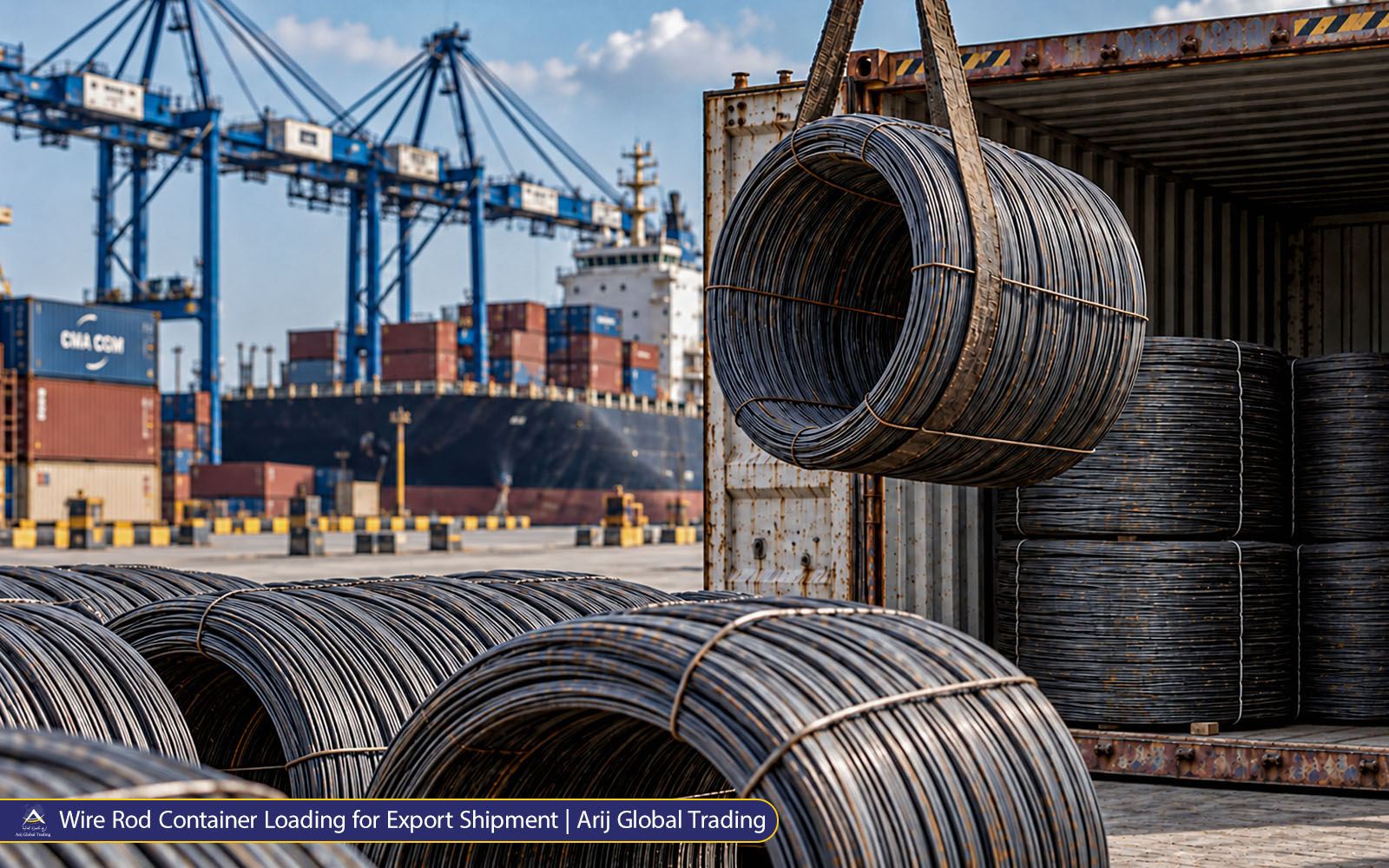
Containerized shipment is often preferred when buyers require flexible destination options, controlled cargo handling, or smaller shipment quantities.
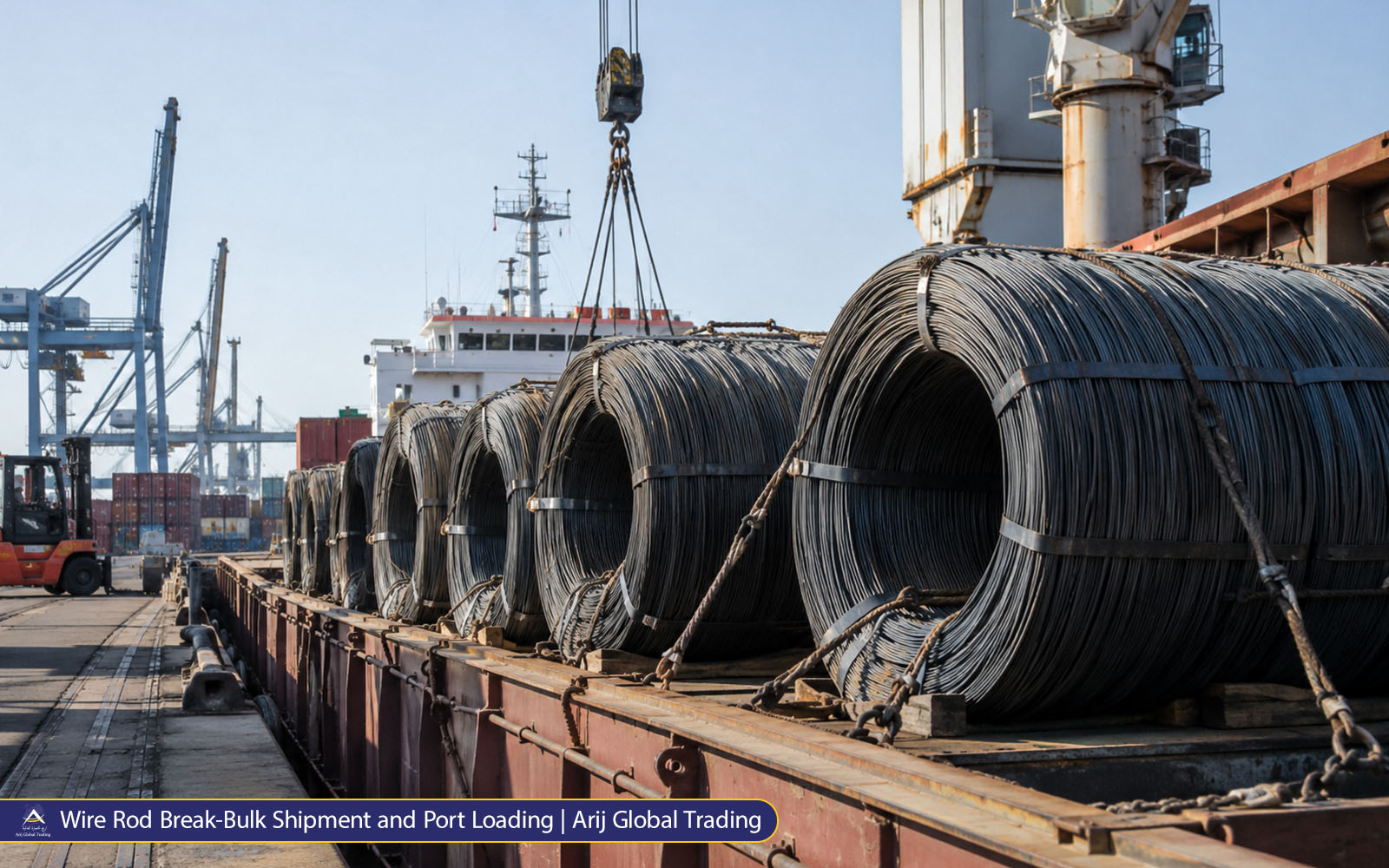
Break-bulk shipment can become more efficient for larger volumes where destination ports and logistics infrastructure are designed for bulk cargo handling.
For international buyers, working with an experienced wire rod exporter helps evaluate the most suitable shipment method based on volume, destination requirements, freight conditions, and delivery timelines.
Wire Rod RFQ Checklist
Arij Global Trading’s Role in Wire Rod Supply
Before requesting quotations, buyers should prepare complete technical and commercial information.
A professional RFQ should include:
✅ Required diameter
✅ Steel grade
✅ Final application
✅ Required quantity
✅ Coil weight requirements
✅ Destination port
✅ Packing preference
✅ Inspection requirements
✅ Delivery timeline
A complete RFQ allows suppliers to provide more accurate quotations and reduces unnecessary revisions during the purchasing process.
Arij Global Trading’s Role in Wire Rod Supply
Arij Global Trading operates as a trading and export partner, connecting international buyers with suitable supply solutions and supporting the commercial process from specification matching through shipment coordination.
The company’s role includes:
- Supplier evaluation and coordination
- Product requirement analysis
- Documentation support
- Export planning
- Containerized and break-bulk shipment coordination
- Commercial support based on buyer requirements
For buyers managing bulk procurement, working with a qualified steel wire rod supplier partner can reduce uncertainty by providing a structured approach to sourcing, documentation, and logistics.
Frequently Asked Questions About Wire Rod Procurement
What diameter ranges are available for wire rod?
Wire rod is commonly supplied in diameter ranges from 5.5 mm to 16 mm. The suitable diameter depends on the final application, processing method, and required product performance.
What industries use steel wire rod?
Steel wire rod is used in construction, automotive components, nail manufacturing, fasteners, springs, cold drawing operations, and general manufacturing industries. Each application requires different technical considerations.
What documents should buyers request before shipment?
Buyers should typically review the Mill Test Certificate (MTC), chemical composition report, mechanical test results, inspection certificate, packing list, and Certificate of Origin before shipment.
What is a reasonable MOQ for bulk wire rod orders?
MOQ depends on supplier capability, grade, and commercial requirements. Bulk wire rod orders commonly start around 500 MT, but buyers should confirm flexibility during the quotation stage.
Should buyers request a trial order before committing to bulk volume?
For a new supplier relationship, a trial order can help verify product quality, documentation accuracy, packaging condition, and delivery performance before increasing order volume.
What is the difference between containerized and break-bulk wire rod shipment?
Containerized shipment is generally suitable for smaller lots and flexible destinations, while break-bulk shipment is often preferred for larger volumes moving through ports with bulk cargo handling capability.